





You will not be allowed to compare more than 4 products at a time
View compareVendor
Angel Exotix AquariumLEOPARD BUSHFISH
LEOPARD BUSHFISH
Regular price
From
€15,00
Sale price
€15,00
Regular price
Unit price
per
Tax included.
Shipping calculated at checkout.
SKU
Product Type
Freshwater FishHurry! Only 8 left in stock
Estimated delivery: 2-3 Days from order date.
Free Shipping & Returns: On orders above €70
- Free Delivery & Free Shipping
- Secure Online Payment
Couldn't load pickup availability
More payment Option
Description
Additional Information
Fish Care
Reviews
Description
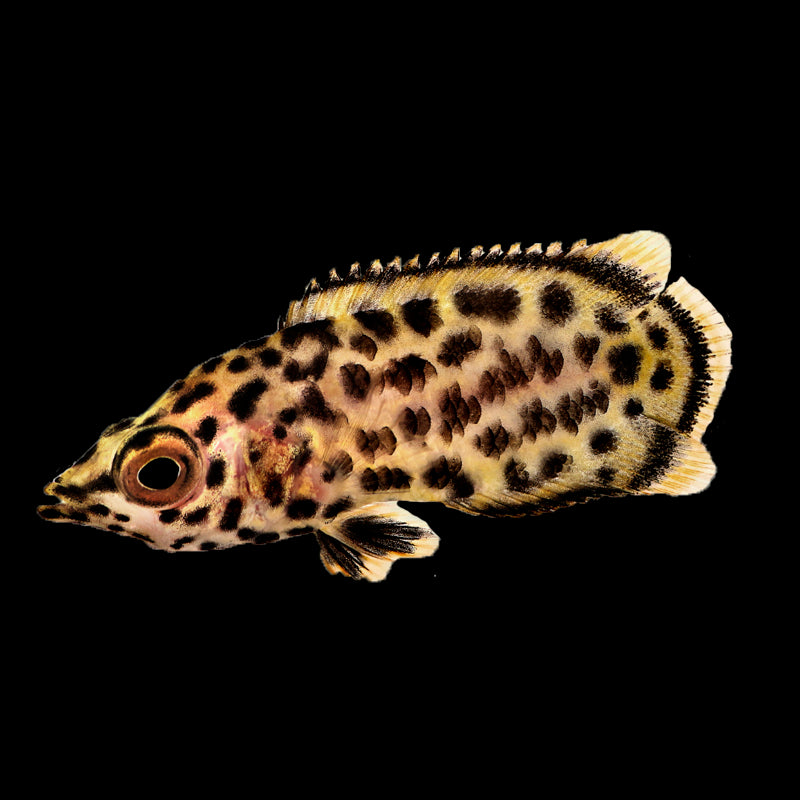
The leopard bushfish is a patient predator, waiting very still until prey passes by.
Physical Characteristics
- Body is rounded and laterally compressed with an elongated snout, wide mouth and large eyes.
- Common length is 6 inches (15 cm).
- Coloration is patterned with a golden-yellow base and brown spots.
- One of the most colorful species of the Ctenopoma genus.
- Exhibit spines on gill covers.
- Males tend to have more spines than females.
Diet / Feeding
- Predatory species; diet consists of fish juveniles, small-sized fish, amphibians, fish eggs, insects, shellfish and small crustaceans.
- To take in food, it will open its mouth, suck in and swallow its prey whole.
- A patient predator; often remaining still waiting for food to pass by.
- Mimics leaves and other aquatic debris while hunting their prey by turning their body completely vertical and bending their caudal tail.
Range / Habitat
- Occurs in tropical, freshwater throughout the middle Congo River basin in the Republic of the Congo, the Democratic Republic of the Congo and Central African Republic.
- Found in many diverse biotopes, including slow-moving waters, stagnant ponds, and fast-flowing streams. They are also present in several major tributary systems.
Reproduction & Growth
- Oviparous; egg-laying species that are egg-scatterers.
- To breed, a pair will embrace and then release eggs and sperm.
- The eggs will float to the surface and stick to the floating vegetation and hatch within 48 hours.
- Adults exhibit no parental care after eggs and sperm are released.
- Females may lay thousands of eggs but fry’s survival rate is typically low.
- Thought to breed seasonally – spawning regularly for several months and then stop for several months.
Conservation Status
- Listed as “Least Concern” on the IUCN Red List.
Additional Information
- Also known as, “Spotted Climbing Perch,” “African Leaf Fish,” and “Leopard Ctenopoma.”
- Scientific name derives from the Latin word acutus meaning “sharp” and rostrum meaning “snout.”
- Typically live 5-10 years.
- Possess a breathing organ (known as the labyrinth organ) that allows the fish to breathe atmospheric air to a certain extent.
- Most active at night and often hides among thick vegetation during the day.
Additional Information
The Angelfish (Pterophyllum scalare ) is a striking species among Fresh water fishes, known for its distinct appearance and unique coloration. Native to the Amazon Basin, this angelfish exhibits a beautiful blend of silvery and golden tones, often with dark vertical stripes running along its body. The striking contrast between the pale body and darker stripes gives the Angelfish a refined, elegant look, making it a popular choice among aquarists.
Angelfish thrive in warm water temperatures between 78°F and 82°F and require a tank of at least 20 gallons to swim comfortably. These fish enjoy a well-planted tank with plenty of hiding spots, as they feel more secure in an environment that mimics their natural habitat. Soft, smooth decorations are preferred, as their delicate fins can be easily damaged by sharp objects or strong currents. A gentle filtration system is recommended to maintain water quality without disturbing the peaceful nature of the fish.
Typically peaceful and non-aggressive, the Angelfish can become territorial, particularly during breeding. They are best kept with other peaceful, non- aggressive tankmates. A varied diet consisting of high-quality flakes, pellets, and live or frozen foods like brine shrimp, bloodworms, and daphnia will help maintain their health and vibrant colors.
With proper care, including regular water changes and stable water conditions, Angelfish can live 5 to 10 years. Their beautiful appearance, combined with their graceful swimming and calm temperament, makes them a stunning and serene addition to any community aquarium.
Angelfish is a fascinating aquarium fish that stands out with its vibrant colors. It belongs to the family Cichlidae and is native to the Freshwater.
This species has a care level of Moderate and requires a minimum tank size of 30 gallons (114 liters). It typically reaches a size of 5-6 inches (13-15 cm).
Preferred water parameters include a specific gravity (sg) of 1.000 - 1.010, pH ranging from 6.0-7.5, and a temperature between 78-82°F (25-28°C). Additionally, maintaining water hardness within the range of 5-12 dGH is essential.
For stocking, the recommended ratio is 1:2 M:F. The Angelfish is widely available and has a diverse diet that includes Omnivorous; will eat flakes, pellets, live foods like worms, and frozen foods like brine shrimp.
With a life span of 8-12 years, this species is known for its very easy care requirements. It is an ideal choice for both beginner and experienced aquarists. Providing a well-maintained tank environment with suitable water conditions will ensure the health and vibrancy of this captivating species.
The Best Food for Angelfish
Angelfish are easy to feed and will take all sorts of fish foods, floating or sinking. Some favorites include krill flakes, freeze-dried bloodworms and tubifex worms, and Hikari Vibra Bites. If you want to fatten up the adults to condition them for breeding, frozen bloodworms are a must-have.
Breeding Your Angel Fish?
It can be hard to spot the differences between males and females. Therefore, the easiest method of getting a breeding couple is to buy at least 6-8 juvenile angelfish, raise them to adulthood, and let them pair off naturally. Observe the Angel Fishes hanging out with the comfortable partner. Pick the best-looking pair and move them to their own Breeding aquarium for spawning. (A 20-gallon high breeding tank is a good size, since it has plenty of height for their fins to fully extend.) Once they breed, you can easily determine the sex since the female is the one laying the eggs.
How often do angelfish lay eggs?
Angelfish readily breed and can lay hundreds of eggs every one to two weeks if the eggs are removed or eaten. (The first couple of spawns often fail because the new parents can end up consuming them.) However, with the right conditions and a little patience, your angelfish can successfully raise their own offspring. The eggs are typically laid on vertical surfaces like a stiff leaf, filter pipe, or a section of aquarium wall. Depending on the tank temperature, the eggs will hatch in two to three days, and the parents may move the newly hatched wigglers (fry that cannot swim freely yet) around the aquarium with their mouths. In another three to four days, the fry become free-swimming, and the parents will protectively keep their cloud of babies between them. At this time, start off the fry with tiny, nutritious foods like baby brine shrimp.
Fish Care
Temperature - 78-82°F (25-28°C)
Breeding setups may require a slightly higher temperature of 28−30°CGeneral Hardness (GH): 3−8 dGH
Soft to moderately hard water is idealMin. Tanksize - 30 gallons (114 liters)
Water Type - 1.000 - 1.010
Suitable PH - 6.0-7.5
Slightly acidic to neutral water conditions.Native - Amazon River Basin, Brazil, North America
Fish Type - Fresh Water
Origin - Captive-Bred
Max Size - 5-6 inches (13-15 cm)
Caring - Moderate
Water Changes: Perform regular water changes to maintain stability and keep nitrate levels low.
Filtration:Use gentle but efficient filtration to maintain clean water without creating strong currents, as they are gentle swimmers
Monitoring:Regularly monitor for ammonia, nitrite, and nitrate levels to ensure excellent water quality
FAQ's
Reviews
You may also like

Sold out
Angel Exotix Aquarium
MANACAPURU ANGELFISH
Regular price
From
€9,99
Sale price
€9,99
Regular price
Unit price
per
Sold out

Sold out
Angel Exotix Aquarium
BLACK ANGEL- VEILTAIL
Regular price
From
€10,00
Sale price
€10,00
Regular price
Unit price
per
Sold out
Angel Exotix Aquarium
Leopard Angelfish | Exotic Aquarium Fish
Regular price
From
€7,99
Sale price
€7,99
Regular price
Unit price
per

Sold out
Angel Exotix Aquarium
BLACK ANGEL
Regular price
From
€5,00
Sale price
€5,00
Regular price
Unit price
per
Sold out
Angel Exotix Aquarium
PLATINUM ANGEL Bring home the stunning
Regular price
From
€9,99
Sale price
€9,99
Regular price
Unit price
per
Angel Exotix Aquarium
BULGARIAN SEAL POINT ANGEL Bring home the stunning
Regular price
From
€14,99
Sale price
€14,99
Regular price
Unit price
per
- Choosing a selection results in a full page refresh.
Back to top